
Doofus of the year

The last time I went into a lab, it was to dig out a DNA sample I was sending to a colleague. As I rummaged fruitlessly, I became aware I was being watched through the door by one of the research assistants. He was rubbing his eyes in affected astonishment at seeing me in a lab coat.

This is for a couple of reasons. One is that, like almost everyone, the further I get from my PhD the less I do labwork. And the other is that a considerable amount of my work is now theoretical. The difference between these can be roughly described as follows. In the lab, I would spend hours, days, weeks nurturing and tweaking exotic combinations of chemicals and cells through absurdly complex equipment, before getting a print out and swearing at it. Now, I spend hours, days, weeks nurturing and tweaking exotic combinations of parameters and data through absurdly complex models, before looking at the screen and swearing at it. OK, that’s not quite true. Most of the models I work with are simple – nothing wrong with that, the best ones all are. My point is that there are similarities.

On the other hand, one of the reasons I was enthusiastic to get out of the lab was that I am simply not a natural lab worker. Through long application I have learned to set up and troubleshoot various simple molecular biology protocols, but this is after a considerable rate of failure. Nay, sheer idiocy.

Yes, I have committed my fair share of stupidity. I once forgot to put a filter paper into a machine and proceeded to use a succession of pumps to take the cells I had been lovingly looking after for a week, having isolated them from my own blood, and dump them down the drain. They were meant to stick to the filter paper, but they couldn’t very well do that if there wasn’t any paper there, could they?

The other night I was having a drink with my friend Seb*, who is a much more accomplished and experienced lab scientist than I am or will ever be. This is all the more remarkable because Seb has an almost preternatural ability to home in on and make dumb mistakes. We were swopping tales of lab stupidity, and he told me one to trump all of mine. He had been growing some E. coli, when he received a telephone call. He sat down to take the call, holding the flask of bacteria in his left hand. When the person on the other end of the line asked him what the time was, he proceeded to look at his watch and pour the flask of bacteria into his lap.

Of course this is not stupid in the way that, say balancing your centrifuge tubes containing DNA preps from two different cultures by pouring back and forth between them is stupid. And no, neither I nor Seb have ever done anything like that. But we know people who have.

I think Lablit needs to give room to this sort of scientific experience as well as the noble pursuit of knowledge. Not to celebrate it exactly. Maybe we need a competition, for the most impressive instance of a scientist acting like a total doofus. Jenny, the ball is in your court

*names have been changed to protect the guilty
On the radio

In case you missed it in the new rolling schedule paradigm, there’s a new podcast up in the (previously) usual Sunday slot for LabLit.com updates.

Currently the podcast is ‘Jenny and Richard wibbling about things that catch their eye’, with the occasional interview thrown in. We’re always on the lookout for new material though, so if you have any ideas (or even better: high-quality AACs/WAVs/Audacity files), send ’em in!

That is all.

On the roof

Earlier today I hugged Eva goodbye and she set off for London Bridge, thence Gatwick and eventually, one hopes, Tronno. She was in London for many reasons, not just to see me and exchange Tweets while seated in my kitchen, about 12 feet away from where I am now.

I’m staying with Richard , and am currently watching him edit a video of interviews he did on Friday night

Unless you’ve been on holiday/living under a rock you’ll probably have heard of the conference with no name: Science Online London (see last year’s account and debrief). This event, which seems to be irrevocably associated in people’s mind with the Borg another ‘Science Online’ conference in the US, took place last Saturday. And you can read all about that in various places, to which I’m not going to link because I can’t be arsed. Well, you could check out the twitter hashtag or Friendfeed (sorry, Eva) room, I guess. Actually, Brian Kelly has an interesting take on preserving all the backchat from the conference and Dave ‘Passport, what passport?’ Munger talks about Second Life.

Where was I? Oh yes.

But the major reason for Eva flying to London was, I like to think, for something that was numerically smaller far more significant in terms of impact, fun, catering, sociability, alcohol consumed and general all-round awesomeness than the official event.

I refer of course to the Fringe Frivolous Unconference, an event so wild, anarchic and hard-hitting that we haven’t been able to standardize the punctuation of the title (which is one reason why Matt’s anagram, ‘Live Roof Surfing’, was so eagerly adopted. By me at least).

Fringe-Frivolous was Jenny‘s brainchild and she was ably assisted by Matt. Food and copious amounts of alcohol (and indeed, the entire venue) were provided by Mendeley—a big shout out to Victor and Cindy for sorting it all.

Jenny has summarized the evening; and Steffi and Eva have also stuck their collective oars in.

However, I’m not going to blog about it. Instead, you may remember me stalking the rooftops with a Flip camera (kindly loaned by Alom Shaha). I’ve edited the clips into a short film that I think captures the essence of the evening perfectly.

Enjoy!

We’re all going on a summer holiday

Looking back over the first week of Lab Literal, I notice that quite a lot has been going on. A couple of rants. A mouse. An ill advised challenge which occupied my readership for all of 3 minutes…

But weeks 2 and 3 are likely to be patchier. I am off to the airport shortly, in the general direction of sunny climes.

If there are any photographs of lab literal interest, I shall post them on my return. For now – have a good week one and all

Lost (or gained) in translation

I wish I could speak more languages.  My French, though far from fluent, is quite sufficient to feel myself to be subtly different while speaking it. The less said about my German the better. That old saw “you gain another language and you gain another soul” has a truth to it, provided one is sufficiently generous in allowing the use of the word ‘soul’.

Flaubert described human speech as “like a cracked tin kettle, on which we hammer out tunes to make bears dance when we long to move the stars”, which sounds pretty much like all language. But some languages do better at some things than others.

Japanese, for instance, has issues with blue and green. There are words for blue, ‘ao’ and green, ‘midori’. But a green light at the famous pedestrian crossings outside Shinjuku station in Tokyo is described as ‘ao’ – blue, even though it is not discernibly different from the green light at Piccadilly Circus or Times Square.

Ao’ is also surrounded by a dense thicket of associations, being linked to notions of freshness and youth, or even unripeness. This means that just as we would say a piece of fruit was too green to be good to eat, a Japanese speaker would use ‘ao’ rather than ‘midori’ – saying it was ‘too blue’. The connotations of rawness extend to metaphors such as a ‘green recruit’ – although in Japanese we would say that she was blue (have a look at James Stanlaw’s chapter on this in “Color categories in Thought and Language” edited by Hardin and Maffi). The reasons for this… I have no clue. I think that until several hundred years ago ‘midori’ was barely used at all. I do know that other languages have similar features and will be delighted to be educated if anyone out there knows the answer.

To play with how different Japanese and English are, not to mention the limitations of online translators, check out Translation Party. This website takes an English phrase, translates it into Japanese, and then back into English, and then to Japanese again. It keeps doing this until it stops changing, at which point it stops and proclaims that ‘equilibrium’ has been reached. Occasionally, the equilibrium contains a surprisingly resonant image which was buried in the original.

For example, this is the equilibrium reached by a famous passage of science writing.

Support for parents CHEKKUWAMU complex plant, using the birds, many kinds of insects, forest soil fun, creative songs flitting, Banking Law, a disease that is crawling.

If you are in the aftermath of longevity, maximum power, and law and, in the case of this form, the evolution of this change, the beauty of my life, I have to create a gravitational pull of the Earth, adding a solution.

What is forest soil fun? And ‘Banking Law, a disease that is crawling’ makes it sound like it has been reading the financial pages. And CHEKKUWAMU?

And as for the second paragraph… well the aftermath of longevity can be only one thing, yet it seems to lead to ‘this change, the beauty of my life’.

I will buy a pint for the first person to work out what this started out as in English. Just so you know it is two sentences, which were input separately. And it is really rather famous.

And I am more in awe of Haruki Murakami‘s translators than ever.

There’s a mouse in my kitchen (what I’m a gonna do?)

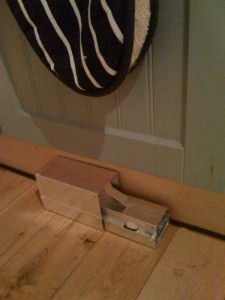
Longworth Trap!!!

Longworth Trap!!!

It’s baited with some cereal, and a squished cherry tomato. The tomato is on the advice of a friend who told me that he once had a positive experience with tomatoes when all else had failed. I mean a positive experience catching mice by the way. Not anything else in particular.

Any other advice?

Why I dread submitting papers

Today I have mostly been writing a paper. It’s pretty nice, and I feel quite pleased with it because it shows something I wasn’t expecting. On the other hand my heart is sinking because I know what is coming shortly. I am going to have to submit it for publication.

Scientists are expected to have a pretty wide range of skills. An enquiring mind and understanding of the scientific method: they should come as standard. But to that you have to add things like specific laboratory expertise, maths and statistics, often a good dollop of programming talent, and perseverance (to a pretty high power). And that is before you finish your PhD. Then come the ever mounting demands of presenting your data, managing your finances (not to mention managing people!) writing papers and grants, reviewing other people’s papers and grants, and yet more perseverance. Eugh.

And at some point journal editors decided that we needed an extra set of hoops. I cannot say how much I fear those words ‘Instructions for authors’. They mean ‘Huge pain in the arse for authors’.

I mean, I am a scientist, not a bloody graphic designer. Some of the instructions for handling images are completely impenetrable to me. Down the corridor there is a computer which is specifically maintained with an old retro version of Powerpoint because in more recent versions it is not possible to save the file in a sufficiently resolved format to be acceptable to some journals. And what’s with this from PLoS?

“…we cannot accept for review or revision any documents created in Microsoft Office 2007, even if “saved down” to the 2003 version.”

There follows some guff about how changes in the new version of Word are

“incompatible with the established workflow processes of many publishers…”

Now I don’t know exactly what an established workflow process is, but it sounds very much like they just can’t be arsed to change things around. Note that I can think of many publishers who do NOT have this problem.

And this isn’t even the point. Check out that statement again; “…cannot accept for review or revision”. They’re insisting on this before they’ve even agreed to publish it! That’s what really gets my goat about scientific publishing. You know as well as I do that an awful lot of papers don’t get into the first journal they go to. That means you have to sit down, and reformat your paper – shaving a few words off the abstract here, changing the titles of the sections there, and then letting your reference management software crash your computer multiple times as you try to get the sodding references in the right format (like many of you, I have stayed up all night re-inserting references over and again in the face of this scourge. Again, I have laptops which have old versions of this software on, because I trust only them to not paralyse my PC*)

And then you sit down with the web based submissions system, where you have to enter every author, and their address, and their phone number. Again.

Why is there not a single format for initial submissions? Better than that, why are all initial submissions not done in pdf? You can make them on your own computer and send them direct. If somebody does not happen to have Acrobat, then the online tools can be used, but as an exception. I can’t understand this. If the Natures and Sciences want to keep up their policy of splitting papers into an often absurdly short summary of results, which is then linked to the supplementary material where the real paper is, then that is fine. But everybody else…?

This has been a long winded way of getting around to this link. It’s not strictly about submitting an article, being instead about a dreadful experience trying to get a journal to accept a technical comment, but in several ways it resonates with my point above (thanks to João Carrico for bringing my attention to it via Twitter).

*Mac users – don’t start

zombies redux

A few years ago I wrote something for lablit explaining infectious disease modelling in terms of zombies. A colleague now brings my attention to a splendid paper entitled “WHEN ZOMBIES ATTACK!: MATHEMATICAL MODELLING OF AN OUTBREAK OF ZOMBIE INFECTION”, which is available here.

May I say how delighted I am that someone is taking this important issue seriously?

UPDATE: zombies discussed on the today programme!  (http://news.bbc.co.uk/today/hi/today/newsid_8206000/8206612.stm)

Lies, lies and uncertainties

“Crikey” was all I could think. Well actually, what I was thinking was considerably ruder than that, but I don’t want my saltier vocabulary to offend. So we’ll stick with “Crikey”.

“Barack Obama is trying to strangle Stephen Hawking!”

Well, that is what I thought at first, then the rational side of my brain took over and figured it out. Why would Obama have it in for Hawking, a hero to millions for his extraordinary achievements in cosmology, against a background of paralyzing neurological disease? And Obama is a pretty smart guy himself by all accounts, so it seems unlikely he would choose to whack the scientist with cameras present.

In fact, Obama was bestowing the Presidential Medal of Freedom on Hawking. The latter was clearly chuffed. And how could he not be? It is the highest civilian award in the US. And Hawking himself isn’t even a US citizen.

Which was why I surprised to hear of the right wing Investors Business Daily, in which an editorial on July 31st stated that

“People such as scientist Stephen Hawking wouldn’t have a chance in the U.K., where the National Health Service would say the life of this brilliant man, because of his physical handicaps, is essentially worthless.”

Gosh. I always though Hawking was English. Maybe I should ask to see his birth certificate?

OK, I know I am way behind on this story, which most people reading this surely know about already. The roots lie in the fact that the new US administration is trying to reform the US healthcare system. If you want to get the rest of the political gist, check out blogs like this one from the Washington Post. But the upshot is that the original editorial was false. It is not certain whether the people writing it were culpably stupid (that’s an artificial voice dumbass!) or culpably dishonest. But something untrue got out into the blogosphere and picked up by organizations and publications which really should know better (like Human Events). Hilariously, when the editorial was ‘corrected’, it was only to state that the original editorial … implied that physicist Stephen Hawking, a professor at the University of Cambridge, did not live in the UK.”

Not that he would be dead if he lived in the UK. See the difference?

Now, the last thing I want to do is weigh into this debate. Especially because I think that it plays directly into the hands of the people posting this and other nonsense. I suspect that the strategy is to somehow cast anything other than the present system as ‘unamerican’, and I don’t think I will help by arguing against it. Especially seeing as I live in North London, have the whole of The Wire on DVD, and shop at Whole Foods. Well, I shop there when I am passing. Most of the time the sainsburys across the road does fine. But I am clearly part of a liberal elite. A liberal, sneering foreign elite.

But I don’t feel smug about my non-americanness. Not at all. Because I live in the UK, which has things like this Daily Mail headline.

‘Tamiflu turned my children into hallucinating, sobbing wrecks’

Note the inverted commas, which is UK press code for “anything between these may well be bollocks and not legally actionable”.

It’s an article by a journalist whose kids, by the sound of it, had a rotten bout with swine flu. But he is blaming the Tamiflu they took rather than the virus. The possibility that some, or indeed all of the problems he describes could be due to the infection is dismissed as follows.

“The effects of swine flu? Not a bit of it. My wife and I are utterly convinced that all these symptoms were, quite simply, the vicious side effects of Tamiflu”

There is some growing concern about precisely how useful Tamiflu is, and how many rare side effects there might be for a drug which has, of necessity, not been in widespread use before now. But as anybody who has done epidemiology or statistics will know, to study this takes much more than a single sample from one concerned parent who happens to have as a mouthpiece the single loudest and most moronic fountainhead of antirationalist nonsense afflicting British society. From the article it is not even clear at which point in the course of infection Tamiflu was administered. Apparently the children were vomiting (yes, another symptom of swine flu) and it is quite possible that the tamiflu was vomited up without being absorbed at all.

I’m not trying to claim Tamiflu is beyond reproach, just that we need a sample size larger than offered by this journalist (among others) before making claims like this. In the absence of such evidence, the content of the article is quite as misleading as the Investors’ Business Daily editorial. The consequences of people failing to take up Tamiflu as a result of the article are hard to predict: if the pandemic remains mild, then they will be comparatively limited. If it turns severe, which is not impossible, then people choosing to abstain from the drug could have dreadful, lethal consequences.

Of course, if this happens, then the Daily Mail article will have been forgotten. Scientists have to stand by and justify what they have said in a way journalists do not. And it is especially sickening to read this given that, were Tamiflu being rationed (and some people think the current policy is mistaken), the Daily Mail would surely be in the front line demanding to know why.

But perhaps the most important thing we need is a way to talk to parents like those journalists, and all the thousands of others who are scared about what is best for their children, without bullying or patronizing them. It’s the old thing about how to communicate uncertainty. There are two such uncertainties here – how dangerous is Swine Flu? And how dangerous is Tamiflu? If untreated swine flu infection is more dangerous than a course of tamiflu, then the drug is wholly justified. We really need to start to think about communicating this before a vaccine becomes available. Because we know how the British press loves a nice vaccine scare.

and so it begins, not with a bang but a whimper

I’m going to start this blog in somewhat contrary fashion. Yesterday I was reading my weekend guardian, and came upon a piece by Shazia Mirza. At the end she wrote “I can’t understand people who write a blog of their everyday life… I really don’t care. Bring back the diary, where people kept their thoughts to themselves.” And the thing is, I agree.

So why am I sat with my laptop on a late Sunday morning writing my first blog entry? Well, it is in large part down to Lablit, the editor of which, Jenny Rohn, has been on at me to blog for literally years. The conversations go something like this.

Jenny: but why don’t you write a blog?

Bill: because I can’t understand why anyone would give a toss about what I have to say.

Jenny: that’s not true. You’re passionate about science, society and culture and you’re as opinionated as anyone I know*, and you like ranting and writing about it. Even if it is only to get things off your chest, it would be good for your blood pressure.

Bill: Yes but there are a million blogs out there nobody pays attention to. It would be like pissing into Niagara.

Jenny: Agreed, but by refusing to engage you make sure that nobody pays attention to you. Have the courage to have a go. You’re not scared are you?

Bill: look do you want another drink? the bar’s closing

Jenny: Don’t change the subject. What’s the worst that could happen?

Well. We are about to find out.

I was going to write something long and involved about lies, politics, the NHS and healthcare reform. But I have to go to the park and play football. Yesterday I watched my team, Arsenal, prove that reports of its demise were much exaggerated as they tonked Everton 1-6. I will remember that success as I fail to bring a single ball under control this afternoon.

*I may be wrong, but I suspect this means I am really quite opinionated.